
The issue of food is very simple. An average human being consumes about 2.5 pounds of food in which .3 pounds is converted into solid waste. For the Mars mission, one human being would have consumed 913.125 pounds of food and produced 109.575 pounds of solid waste. Eventhough that solid waste can be vented to outer space, the numbers give us an idea of how much waste one can produce. Saving weight for food can be extremely difficult. Unlike water and air, it can not be converted into something a human desperately needs. However, it can turn to fertilizer and if we are going to grow plants on our space crafts, that fertilizer can be used to help the plants grow faster and healthier. Another way our astronauts can save weight is by simply creating food aboard the space craft. They can carry varios seeds that do not weight much. By adding wastes such as carbon dioxide and solid waste, they can be grown to edible food. This way, large amounts of weight can be reserved for other payloads.
Space Food History
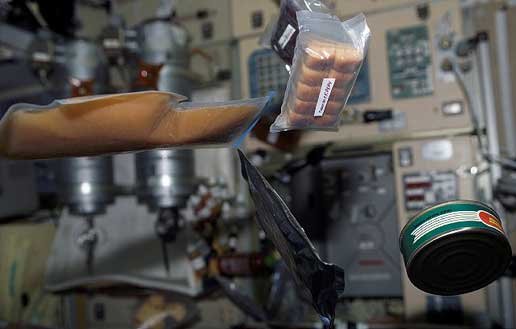
The food that NASA's early astronauts had to eat in space is a testament to their fortitude. John Glenn, America's first man to eat anything in the near-weightless environment of Earth orbit, found the task of eating fairly easy, but found the menu to be limited. Other Mercury astronauts had to endure bite-sized cubes, freezedried powders, and semiliquids stuffed in aluminum tubes. Most agreed the foods were unappetizing and disliked squeezing the tubes. Moreover, freeze-dried foods were hard to rehydrate and crumbs had to be prevented from fouling instruments.
The astronauts complained and on the Gemini missions eating improved somewhat. The first things to go were the squeeze tubes. Bite-sized cubes were coated with gelatin to reduce crumbling, and the freeze-dried foods were encased in a special plastic container to make reconstituting easier. With improved packaging came improved food quality and menus. Gemini astronauts had such food choices as shrimp cocktail, chicken and vegetables, butterscotch pudding, and apple sauce, and were able to select meal combinations themselves.
By the time of the Apollo program, the quality and variety of food increased even further. Apollo astronauts were first to have hot water, which made rehydrating foods easier and improved the food's taste. These astronauts were also the first to use the "spoon bowl," a plastic container that could be opened and its contents eaten with a spoon.
The task of eating in space got a big boost in Skylab. Unlike previous space vehicles for astronauts, Skylab featured a large interior area where space was available for a dining room and table. Eating for Skylab's three-member teams was a fairly normal operation: footholds allowed them to situate themselves around the table and "sit" to eat. Added to the conventional knife, fork, and spoon was a pair of scissors for cutting open plastic seals. Because Skylab was relatively large and had ample storage area, it could feature an extensive menu: 72 different food items. It also had a freezer and refrigerator, a convenience no other vehicle offered.
Almost like eating at home
During a typical meal in space, a meal tray is used to hold the food containers. The tray can be attached to an astronaut's lap by a strap or attached to a wall. The meal tray becomes the astronaut's dinner plate and enables him or her to choose from several foods at once, just like a meal at home. Without the tray, the contents of one container must be completely consumed before opening another. The tray also holds the food packages in place and keeps them from floating away in the microgravity of space.
Conventional eating utensils are used in space. Astronauts use knife, fork, and spoon. The only unusual eating utensil is a pair of scissors used for cutting open the packages. Following the meal, food containers are discarded in the trash compartment below the mid-deck floor. Eating utensils and food trays are cleaned at the hygiene station with premoistened towelettes.
Crews have reported that the Shuttle food system functions well in space. It consists of familiar, appetizing, well-accepted food items that can be prepared quickly and easily. A full meal for a crew of four can be set up in about 5 minutes. Reconstituting and heating the food takes an additional 20 to 30 minutes about the time it takes to fix a snack at home, and far less than it takes to cook a complete meal.
Shuttle Galley
The Shuttle galley was redesigned in 1991 to reduce the weight and volume and to update the electronics. The redesigned galley weighs one-third less and occupies one-half the volume of the original galley. The new galley delivers hot or cold water from the rehydration station. The hot water temperature is between 155 and 165deg.F. The hot and cold dispense quantities can be selected in one-half ounce increments up to 8 ounces.
The forced air convection oven heats food and beverages by conduction with a hot plate or by forced convection. The temperature of the oven is maintained at 160 to 170deg.F. The oven holds 14 rehydratable packages plus thermostabilized pouches and beverages.
Space Station Food System>
Space Station will become operational on a full time basis with a crew of 4. Later, the crew size will grow to a maximum of 8 people. The crew will reside in the Habitation Module (HAB). Food and other supplies will be resupplied every 90 days by exchanging the Pressurized Logistics Module (PLM).
The food system for SS will be considerably different from the Shuttle food system. Since the electrical power for SS will be from solar panels, there is no extra water generated onboard. Water will be recycled from the cabin air, but that will not be enough for use in the food system. Most of the food planned for SS will be frozen, refrigerated, or thermostabilized and will not require the addition of water before consumption. Many of the beverages will be in the dehydrated form. Food will be heated to serving temperature in a microwave/forced air convection oven. One oven will be supplied for each group of 4 astronauts.
The SS food system consists of 3 different supplies of food; Daily Menu, Safe Haven, and Extra Vehicular Activity (EVA) food.
The Shuttle food system

The kinds of foods the Space Shuttle astronauts eat are not mysterious concoctions, but foods prepared here on Earth, many commercially available on grocery store shelves. Diets are designed to supply each Shuttle crew member with all the Recommended Dietary Allowances (RDA) of vitamins and minerals necessary to perform in the environment of space. Caloric requirements are determined by the National Research Council formula for basal energy expenditure (BEE). For women, BEE = 655 + (9.6 x W) + (1.7 x H) - (4.7 x A), and for men, BEE = 66 + (13.7 x W) + (5 x H) - (6.8 x A), where W = weight in kilograms, H = height in centimeters, and A = age in years.
Shuttle astronauts have an astonishing array of food items to choose from. They may eat from a standard menu designed around a typical Shuttle mission of 7 days, or may substitute items to accommodate their own tastes. Astronauts may even design their own menus. But those astronaut-designed menus must be checked by a dietitian to ensure the astronauts consume a balanced supply of nutrients.
The standard Shuttle menu repeats after 7 days. It supplies each crew member with three balanced meals, plus snacks. Each astronaut's food is stored aboard the Shuttle and is identified by a colored dot affixed to each package.
Space Pantry

A supplementary food supply that provides approximately 2100 Kilocalories per person for two extra days is stowed aboard the Shuttle for each flight. Pantry items are flown in addition to the menu in case the flight is unexpectedly extended because of bad weather at the landing site or some other unforeseen reason. During the flight, this food supply provides extra beverages and snacks. The pantry items also can be exchanged for menu items in flight, but all unused food packages are retained in the pantry so they will be available in case they are needed later.
Orbiter's Food Lockers
Meals are stowed aboard the orbiter in locker trays with food packages arranged in the order they will be used. A label on the front of the locker tray lists the locker contents. A five-section net restraint keeps food packages from floating out of the locker in microgravity while still allowing items inside to be seen. Velcro strips secure sections of the net, making it easily opened and the food items readily accessible to the astronauts.
Food is packaged and stowed in the locker trays in Houston about a month before each launch. Stowed food lockers and shipping containers are kept under refrigeration. About 3 weeks before launch, the food lockers are shipped to Kennedy Space Center (KSC) in Florida. There they are refrigerated until they are installed in the Shuttle 2-3 days before launch. Besides the meal and pantry food lockers, a fresh food locker is packed at KSC and installed on the Shuttle 18 to 24 hours before launch. The fresh food lockercontains tortillas, fresh bread, breakfast rolls, and fresh fruits and vegetables such as apples, bananas, oranges, and carrot and celery sticks.
Safe Haven Food
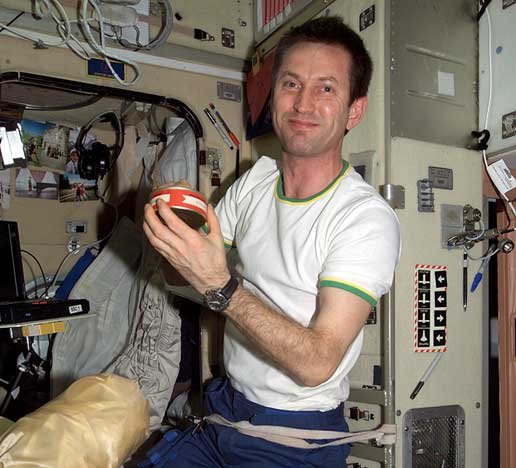
The Safe Haven food system is provided to sustain crewmembers for 22 days under emergency operating conditions resulting from an on-board failure. A goal of the system is to utilize a minimal amount of volume and weight. The Safe Haven food system is independent of the daily menu food and will provide at least 2000 calories daily per person. The Safe Haven food system will be stored at ambient temperatures which range from 60 to 85deg.F. Therefore, the food must be shelf-stable. Thermostabilized entrees and fruits, intermediate moisture foods, and dehydrated food and beverages will be used to meet the shelf-stable requirement. The shelf life of each food item will be a minimum of two years.
A Taste of Space
Whet your readers' appetite with little-known food facts from space that give new definition to eating out.
The first American astronaut to eat in space dined on applesauce squeezed from a no-frills, aluminum toothpaste-like tube. Since then, food technology has cooked up better ways to prepare, package and preserve space fare in a tastier, more appetizing fashion.
Today, humans are living in space aboard the International Space Station for as long as six months at a time. As America journeys back to the Moon and on to Mars, advances for food to withstand years in space will serve up more improvements in space and on Earth.
Food Preparation

On the Space Shuttle, food is prepared at a galley installed on the orbiter's mid-deck. The galley is a modular unit that contains a water dispenser and an oven. The water dispenser is used for rehydrating foods, and the galley oven is for warming foods to the proper serving temperature.
Shuttle Extended Duration Missions
The length of Shuttle missions has steadily increased from the first mission in 1981 of 2 days, to 14 days for STS-50 in June, 1992. Missions beyond 10 days are called Extended Duration Orbiter (EDO) missions. In order to accommodate the weight and volume of trash generated by the food system on these longer missions, it was necessary to develop new food and beverage packages. A trash compactor was also developed to reduce the volume of the trash, and the new packages were designed to be compatible with the compactor.
The beverage package is made from a foil laminate to provide maximum barrier properties for a longer product shelf life. A septum adapter is sealed in the package after the beverage powder has been added. The septum adapter holds a septum which interfaces with the galley water dispenser for the addition of water, and with a straw for drinking the beverage. Although the beverage package was designed for use on EDO missions, it has replaced the square polyethylene beverage package on all Shuttle missions. The EDO rehydratable food package also is made from flexible material to aid in trash compression. The rehydratable package consists of a flexible bowl and lid with the septum adapter for adding water from the galley. Velcro on the bottom of the package holds it in the meal tray. After adding the required amount of water to the package, it is placed in the oven if the food is to be served hot, or directly onto the serving tray if it is to be served cold. The top of the package is cut off with a knife or scissors and the contents eaten with a fork or spoon. The EDO rehydratable food package was tested on STS-44, and used for all of the rehydratable foods on STS-49 and 50. It has now permanently replaced the rigid square rehydratable package.
Daily Menu
Foods chosen for the daily menu were selected based on their commonality to everyday eating, the nutritional content and their applicability to use in space. The Daily Menu food supply is based on the use of frozen, refrigerated, and ambient foods. Frozen food includes most entrees, vegetable, and dessert items. Refrigerated food includes fresh and freshtreated fruits and vegetables, extended shelf-life refrigerated foods, and dairy products. Ambient foods include thermostabilized, aseptic-fill, shelf-stable natural form foods, and rehydratable beverages.
Astronauts will choose 28 day flight menus approximately 120 days prelaunch. Additions, deletions, or substitutions to a standard Space Station menu will be made using a Space Station foodlist.
The packaging system for the Daily Menu food is based on single service, disposable containers. Food items will be packaged as individual servings to facilitate inflight changes and substitutions to preselected menus. Single service containers also eliminates the need for a dishwasher. A modular concept that maintains a constant width dimension is utilized in the package design. This design permits common interface of food packages with restraint mechanisms (stowage compartments, oven, etc.) and other food system hardware such as the meal tray. Five package sizes were designed to accommodate common serving sizes of entrees, salads, soups, and dessert items. Several fresh fruits, bread, and condiments will be provided in bulk packages.
The food required for a 90 day mission will be delivered to the station in the PLM. Daily menu frozen, refrigerated and ambient foods will be stowed in 14 day supply increments. The HAB galley will accommodate a 14 day food supply. Food will be transferred from the PLM to the HAB every two weeks. Unused food will be returned to the proper stowage environment in the PLM with each 14 day food transfer. Inventory control will be maintained on the unallocated food returned to the PLM for use in case the Shuttle is late in delivering the next food set.
EVA Food
EVA food consisting of food and drink for 8 hours (500 calories of food, and 38 oz. of water) will be available for use by a crewmember during each EVA activity. EVA water and food containers will be cleaned and refilled with galley subsystems.
Astronaut Menu Selection

Food evaluations are conducted approximately eight to nine months before the flight. During the food evaluation sessions, the astronaut is given the opportunity to sample a variety of foods and beverages available for flight. A pack of information is given to each astronaut to use in planning their personal preference menus. Included in the packet is a standard menu, training menu, past flight menus the astronaut has chosen, and the baseline shuttle food and beverage list.
Astronauts select their menu approximately five months before flight. The menus are analyzed for nutritional content by the Shuttle Dietitian and recommendations are made to correct any nutrient deficiencies based on the Recommended Dietary Allowances. The menus are then finalized and provided to the Flight Equipment Processing Contractor (FEPC) in Houston three months before launch. The FEPC processes, packages, and stows the food in the Shuttle lockers before being transferred to KSC.