Many of us stuck on Earth wish we could join (at least temporarily) the Expedition One crew aboard the International Space Station (ISS). Floating effortlessly from module to module, looking down on Earth from a breathtaking height of 350 kilometers.... It's a dream come true for innumerable space lovers
But be careful what you wish for! Living on the Space Station also means hard work, cramped quarters, and... what's that smell? Probably more outgassing from a scientific experiment or, worse yet, a crewmate.
With 3 to 7 people sharing a small enclosed volume on the still-growing Space Station, air management is critical.
Life support systems on the ISS must not only supply oxygen and remove carbon dioxide from the cabin's atmosphere, but also prevent gases like ammonia and acetone, which people emit in small quantities, from accumulating. Vaporous chemicals from science experiments are a potential hazard, too, if they combine in unforeseen ways with other elements in the air supply.
So, while air in space is undeniably rare, managing it is no small problem for ISS life support engineers.
In this second article in a series about the practical challenges of living in space, Science@NASA examines how the ISS will provide its residents with the breath of life.
Breathing Easy on the Space Station
The Expedition One crew -- Bill Shepherd, Sergei Krikalev and Yuri Gidzenko -- aboard the Space Station. During their four-month stay, the crew will relied on the station's hardware to provide breathable air.
Most people can survive only a couple of minutes without oxygen, and low concentrations of oxygen can cause fatigue and blackouts.
To ensure the safety of the crew, the ISS will have redundant supplies of that essential gas.
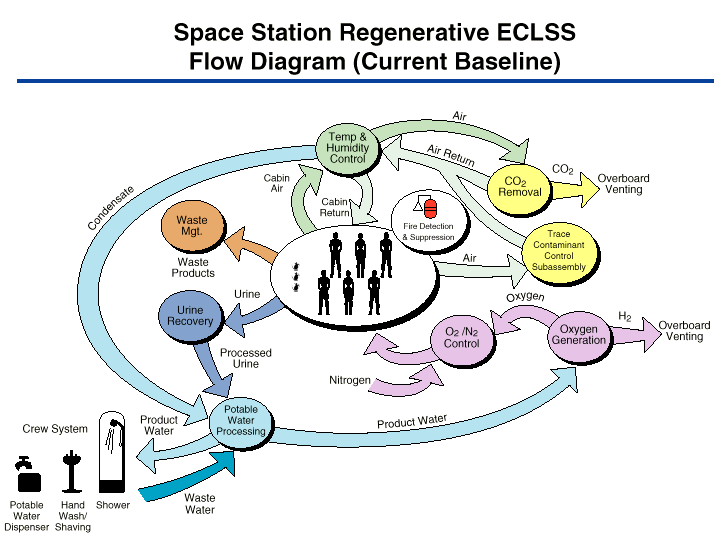
"The primary source of oxygen will be water electrolysis, followed by O2 in a pressurized storage tank," said Jay Perry, an aerospace engineer at NASA's Marshall Space Flight Center working on the Environmental Control and Life Support Systems (ECLSS) project. ECLSS engineers at Marshall, at the Johnson Space Center and elsewhere are developing, improving and testing primary life support systems for the ISS.
Most of the station's oxygen will come from a process called "electrolysis," which uses electricity from the ISS solar panels to split water into hydrogen gas and oxygen gas. Each molecule of water contains two hydrogen atoms and one oxygen atom. Running a current through water causes these atoms to separate and recombine as gaseous hydrogen (H2) and oxygen (O2).
The oxygen that people breathe on Earth also comes from the splitting of water, but it's not a mechanical process. Plants, algae, cyanobacteria and phytoplankton all split water molecules as part of photosynthesis -- the process that converts sunlight, carbon dioxide and water into sugars for food. The hydrogen is used for making sugars, and the oxygen is released into the atmosphere.
"Eventually, it would be great if we could use plants to (produce oxygen) for us," said Monsi Roman, chief microbiologist for the ECLSS project at MSFC. "The byproduct of plants doing this for us is food." However, "the chemical-mechanical systems are much more compact, less labor intensive, and more reliable than a plant-based system," Perry noted. "A plant-based life support system design is presently at the basic research and demonstration stage of maturity and there are a myriad of challenges that must be overcome to make it viable."
Breathing Easy on the Space Station
The oxygen that humans and animals breathe on Earth is produced by plants and other photosynthetic organisms such as algae.
Hydrogen that's leftover from splitting water will be vented into space, at least at first. NASA engineers have left room in the ECLSS hardware racks for a machine that combines the hydrogen with excess carbon dioxide from the air in a chemical reaction that produces water and methane. The water would help replace the water used to make oxygen, and the methane would be vented to space.
"We're looking to close the loop completely, where everything will be (re)used," Roman said. Various uses for the methane are being considered, including expelling it to help provide the thrust necessary to maintain the Space Station's orbit.
At present, "all of the venting that goes overboard is designed to be non-propulsive," Perry said.
The ISS will also have large tanks of compressed oxygen mounted on the outside of the airlock module. These tanks will be the primary supply of oxygen for the U.S. segment of the ISS until the main life support systems arrive with Node 3 in 2005. After that, the tanks will serve as a backup oxygen supply.
Last week, while the crew were waiting for activation of a water electrolysis machine on the Zvezda Service Module, they breathed oxygen from "perchlorate candles," which produce O2 via chemical reactions inside a metal canister.
"You've got a metallic canister with this material (perchlorate) packed inside it," Perry explained. "They shove this canister into a reactor and then pull an igniter pin. Once the reaction starts, it continues to burn until it's all used." Each canister releases enough oxygen for one person for one day."
"It's really the same technology that's used in commercial aircraft," he continued. "When the oxygen mask drops down, they say to yank on it, which actuates the igniter pin. That's why you have to give it a tug to begin the flow of oxygen."
At present, carbon dioxide is removed from the air by a machine on the Zvezda Service Module based on a material called "zeolite," which acts as a molecular sieve, according to Jim Knox, a carbon dioxide control specialist at MSFC. The removed CO2 will be vented to space. Engineers are also thinking of ways to recycle the gas. In addition to exhaled CO2, people also emit small amounts of other gases.
Methane and carbon dioxide are produced in the intestines, and ammonia is created by the breakdown of urea in sweat. People also emit acetone, methyl alcohol and carbon monoxide -- which are byproducts of metabolism -- in their urine and their breath. Activated charcoal filters are the primary method for removing these chemicals from the air.Maintaining a healthy atmosphere is made even more complex by the dozens of chemicals that will be used in the science experiments on board the ISS.